


Introduction
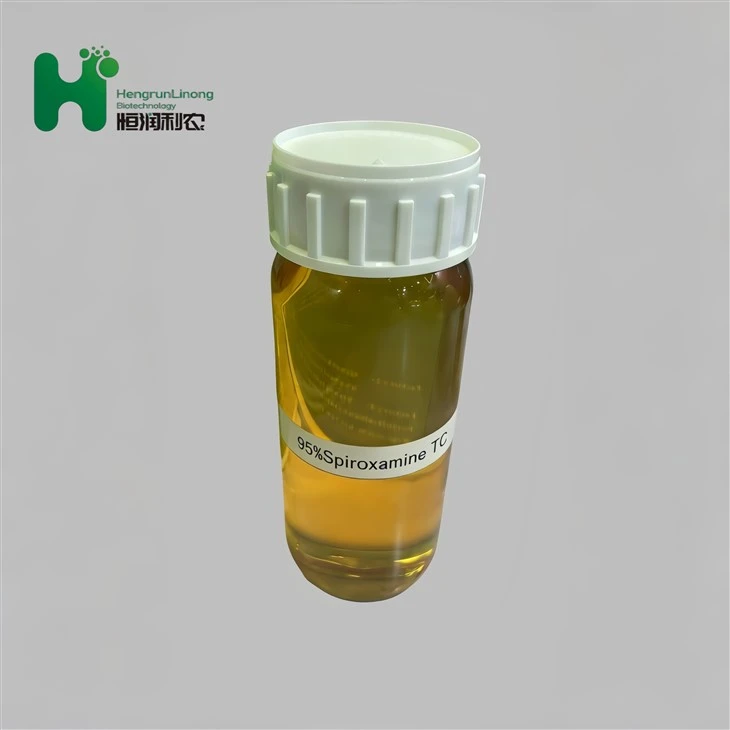
Spiroxamine 95% TC is a highly effective, systemic fungicide concentrate belonging to the spiroketal-amine class. It is primarily used as a technical material to control powdery mildew in cereals (wheat, barley) and grapes. It functions by inhibiting sterol biosynthesis-targeting the Δ14-reductase and Δ8→Δ7-isomerase enzymes-to disrupt fungal cell membrane formation. As a high-purity technical material (appearing as a light brown viscous liquid), it offers key advantages including protective, curative, and eradicative action, rapid plant penetration, and long-lasting residual control, making it an effective tool for resistance management when rotated or mixed with other fungicides. This 95% TC grade is intended for industrial formulation into end-use products such as emulsifiable concentrates (EC).
Products Detail
|
Common Name |
Spiroxamine |
|
Technical Grade |
95% TC (Technical Concentrate) |
|
CAS Number |
118134-30-8 |
|
Molecular Formula |
C18H35NO2 |
|
Molecular Weight |
297.5 g/mol |
|
IUPAC Name |
8-tert-butyl-1,4-dioxaspiro[4.5]decan-2-ylmethyl(ethyl)(propyl)amine |
|
Appearance |
Light brown oily liquid . |
|
Density |
0.930 g/ml at 20°C . |
|
Melting Point |
< -170°C . |
|
Boiling Point |
Decomposes above 120°C . |
|
Vapor Pressure |
1.7 × 10⁻² Pa at 20°C . |
|
Stability |
Stable for 8 weeks at 54°C, 52 weeks at 30°C, and 24 months at ambient temperatures |
|
Acute Oral LD50 |
~500-595 mg/kg for rats (WHO Class II Moderately hazardous) . |
|
Acute Percutaneous LD50 |
>1068-1600 mg/kg for rats . |
|
Inhalation LC50 (4h) |
~1982-2772 mg/m³ for rats . |
|
Skin & Eye |
Severe skin irritant; not an eye irritant . |
|
ADI (Acceptable Daily Intake) |
0.025 mg/kg body weight . |
|
Ecotoxicity |
Toxic to aquatic life |
|
Target Diseases |
Highly effective against powdery mildew in cereals (caused by Erysiphe graminis) and grapes (caused by Uncinula necator). It also provides good control of various rust diseases |
Product Feature and Application
As a 95% technical concentrate, it features protective, curative, and eradicative systemic action with rapid penetration into leaf tissue and acropetal translocation for uniform distribution . Its primary application is controlling powdery mildew in cereals (Erysiphe graminis) at 500-750 g/ha and grapes (Uncinula necator) at 400 g/ha, while also providing good control of various rust diseases (Rhynchosporium and Pyrenophora teres) with some side-effects against Septoria . The product can be used alone or mixed with triazole fungicides, as tank mixes have been shown to positively influence triazole uptake in plants . This technical grade material (95% TC) is intended for industrial formulation into various end-use products including emulsifiable concentrates (EC), suspension concentrates (SC), and water-dispersible granules (WDG) . Safety considerations include WHO Class II toxicity classification, skin irritation potential, and toxicity to aquatic life.
Target Crops & Diseases
(1)Wheat – Powdery Mildew (Erysiphe graminis)
Key benefits in wheat:
Highly effective control of powdery mildew in wheat
Rapid penetration and systemic movement in leaf tissue
Protects yield and grain quality during critical growth stages
Spiroxamine is widely used in wheat disease management programs, especially in regions with high humidity where powdery mildew pressure is common.


(2)Barley – Powdery Mildew and Rust Diseases
Key benefits in barley:
Effective control of powdery mildew in barley crops
Provides additional activity against rust diseases
Helps maintain crop health and improve grain quality
Spiroxamine is commonly used in cereal crop protection programs, often in combination with other fungicides.
(3)Rye and Oats – Foliar Fungal Diseases
Key benefits in rye and oats:
Controls powdery mildew infections in cereal crops
Protects foliage and improves plant vigor
Helps maintain stable crop yield under disease pressure
Spiroxamine is widely used for broad cereal disease protection.


(4)Grapes – Powdery Mildew (Uncinula necator)
Key benefits in grapes:
Highly effective control of grape powdery mildew
Protects leaves, shoots, and fruit clusters
Improves fruit quality and vineyard productivity
Spiroxamine is widely used in vineyard disease management programs, particularly in regions with warm and humid climates where powdery mildew pressure is high.
Product Qualification
- Registration certificate:EX20220072
- Production qualification:The production workshop complies with Good Manufacturing Practice (GMP) standards for pesticides and is equipped with professional raw material testing and finished product inspection equipment. Each batch of products undergoes multiple quality control tests.
- Relative Documents:Third-party authoritative testing institutions shall issue reports ,including five-batches;Physical and Chemical;Toxicology.
- Production capacity:With standardized production lines and comprehensive process control, we ensure stable batch supply of products.
Frequently Asked Questions
A. Why is our Spiroxamine 95% TC the right choice for your portfolio?
Our product offers high purity (95% TC), consistent batch quality, and stable physicochemical properties, ensuring smooth formulation and predictable field performance.
With rapid systemic penetration and long residual activity, it delivers strong control of powdery mildew in cereals and grapes - even under high disease pressure.
For formulation companies, this means:
- Reliable efficacy
- Stable production performance
- Reduced quality complaints
- Strong market competitiveness
B. What competitive advantages does Spiroxamine provide in the field?
Spiroxamine features a dual sterol biosynthesis inhibition mechanism, targeting two key enzymes in fungal cell membrane formation.
This provides:
- Fast curative and eradicative activity
- Long-lasting residual control
- Excellent compatibility in resistance management programs
- Strong tank-mix performance with triazoles
It is a powerful partner for resistance rotation strategies in modern crop protection programs.
C. Which crops and diseases can it support?
Spiroxamine is widely used for controlling:
- Powdery mildew in wheat, barley, rye, and oat
- Powdery mildew in grapes
- Various rust diseases
It helps growers protect yield potential and improve crop quality in both temperate and high-humidity growing regions.
D. Is this product suitable for flexible formulation development?
Yes. Our 95% technical concentrate is ideal for manufacturing:
- EC (Emulsifiable Concentrate)
- SC (Suspension Concentrate)
- WDG (Water-Dispersible Granules)
It demonstrates good stability, compatibility, and processing adaptability, supporting efficient formulation development and scale production.
E. How do you ensure quality, compliance, and supply reliability?
We operate under GMP-compliant production standards with advanced raw material testing and finished-product inspection systems.
Available documentation includes:
- Registration certificate
- GLP 5-batch studies
- GLP physical & chemical data
- GLP Toxicology reports
- Third-party testing reports
Each batch undergoes strict multi-stage quality control to ensure stable purity and performance.
F. What are the common co-formulations of Spiroxamine in the global crop protection market?
(1)Spiroxamine + Prothioconazole
(2)Spiroxamine + Prothioconazole + Bixafen
(3)Spiroxamine + Prothioconazole + Trifloxystrobin
(4)Spiroxamine + Difenoconazole
(5)Spiroxamine + Tebuconazole + Triadimenol
G. Can Spiroxamine be used in resistance management programs?
Yes. Spiroxamine belongs to the morpholine class of fungicides (FRAC Group 5) and works by inhibiting sterol biosynthesis in fungal cell membranes. Because of its unique mode of action, it is widely used in resistance management programs and is often combined with triazoles, SDHIs, or QoI fungicides to improve efficacy and delay resistance development.
H. What makes Spiroxamine particularly effective against powdery mildew?
Spiroxamine provides strong curative and protective activity against powdery mildew pathogens. It rapidly penetrates plant tissues and disrupts fungal cell membrane formation, effectively stopping fungal growth even after infection has occurred. This fast systemic movement and curative effect make it especially valuable for controlling powdery mildew in cereals, grapes, and other crops.
I. Is Spiroxamine suitable for use in cereal crop protection programs?
Yes. Spiroxamine is widely used in cereal disease management programs, particularly for wheat and barley. It provides effective control of powdery mildew, rusts, and other foliar diseases. When used in combination with other fungicides, it offers broad-spectrum protection and helps maintain crop health and yield potential.
J. What are the storage and handling recommendations for Spiroxamine 95% TC?
Spiroxamine 95% TC should be stored in a cool, dry, and well-ventilated area, away from direct sunlight, heat sources, and moisture. Containers should remain tightly sealed and kept away from food, feed, and incompatible materials. During handling, operators should use appropriate personal protective equipment (PPE) such as gloves, protective clothing, and eye protection to ensure safe operation.
K. Do you provide technical and regulatory support for formulation partners?
Yes. We provide comprehensive technical and regulatory support for our formulation partners. This includes product specifications, formulation guidance, analytical support, and regulatory documentation required for product registration in different markets. Our team works closely with partners to ensure efficient product development and successful market entry.
Hot Tags: spiroxamine 95% tc, China spiroxamine 95% tc manufacturers, suppliers, factory, Spiroxamine 95 TC, Quinoxyfen 98 TC, Cyprodinil 98 TC, technical concentrate, Pyriproxyfen 98 TC, Flusilazole 95 TC