

As a technical sales specialist with years in the agrochemical industry, I spend a lot of time walking growers and formulation managers through the nitty-gritty of our products-not just what they do, but how they work. If you've ever stood in a field, staring down powdery mildew or botrytis blight that's spread faster than you can spray, you know that understanding a fungicide's mode of action isn't just textbook science: it's the difference between protecting a $100k crop and losing it to avoidable disease. Today, I want to break down exactly how our Cyprodinil 75 WDG works, why it's a workhorse for so many fruits, vegetables, and ornamentals, and how it fits into a smart, resistance-managed spray program alongside other proven fungicides.
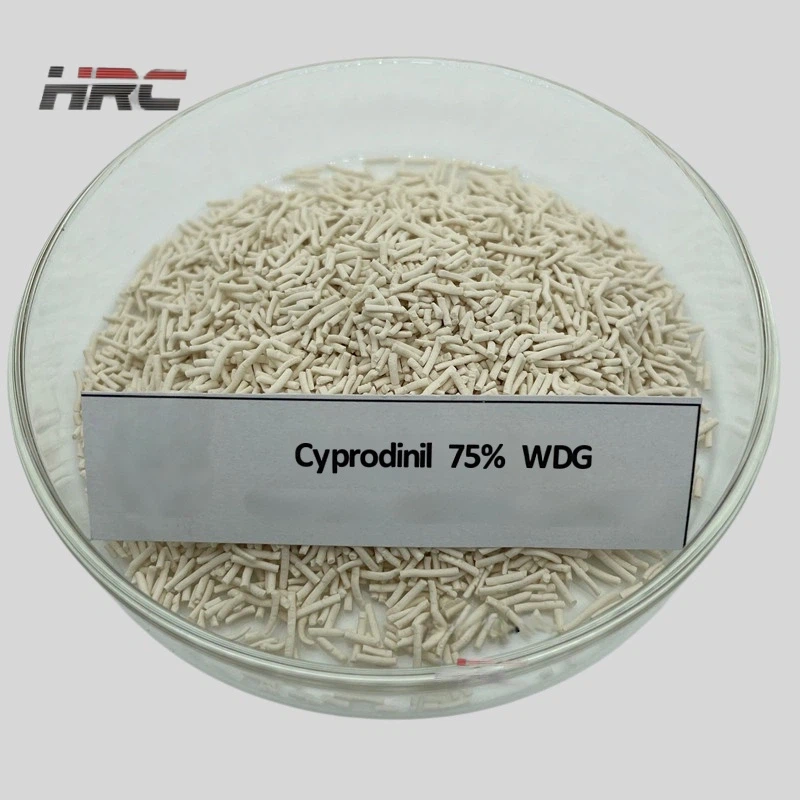
First, let's start with the basics to ground this. Cyprodinil is a pyrimidinamine fungicide, a class that's stood the test of time for its broad activity against ascomycete and deuteromycete pathogens-two groups that cause some of the most costly crop diseases. Our Cyprodinil 75 WDG is a water-dispersible granule, which means it mixes easily in spray tanks, leaves minimal residue on equipment, and delivers a consistent, uniform dose to every part of the plant canopy, even tight, dense growth like grape clusters or berry bushes. But the magic isn't just in the formulation; it's in how it interacts with the fungi that cause disease.
Let's get specific about the mode of action, because this is where a lot of generic fungicide descriptions gloss over key details. Fungi that cause crop diseases don't just sit on the leaf surface-they germinate, penetrate the plant's tissue, and then feed and reproduce inside the cells and spaces between cells. Cyprodinil doesn't just kill fungi after they've already established an infection; it stops them before they take hold, and even suppresses their ability to produce spores that would spread disease to new areas.
At the cellular level, cyprodinil targets two critical biological processes in fungal cells, both of which are unique to fungi (meaning it's low toxicity to mammals, birds, and beneficial insects like bees when used as directed-something we pride ourselves on at our company). First, it disrupts amino acid biosynthesis. Fungi need certain amino acids, like methionine, to build proteins, grow new cell walls, and produce the enzymes that help them penetrate plant tissue. Cyprodinil blocks the pathway that the fungus uses to synthesize these essential amino acids, so without them, the fungus can't germinate from a spore. It also prevents existing fungal mycelium (the thread-like structures that make up the body of a fungus) from growing and expanding into healthy plant tissue. That's why you'll often hear our agronomists say cyprodinil is a preventative and early curative product-it stops infection before it becomes a full-blown epidemic.
The second key action is suppressing spore production. Once a fungus has successfully colonized a plant, it produces thousands (even millions) of spores that are carried by wind, rain, or insects to other plants. Cyprodinil doesn't just stop new infections; it also prevents already infected tissue from producing these spores. That's a huge benefit for disease management, because it breaks the disease cycle at its source. For example, in grapes infected with botrytis bunch rot (one of the most devastating diseases for wine and table grapes), spraying at the right growth stage with cyprodinil doesn't just protect the current bunch-it stops that bunch from releasing spores that would infect next year's crop or nearby fields.
Now, let's talk about why this specificity matters, and how to use cyprodinil effectively to avoid resistance. Fungicide resistance is a real, growing problem, especially for diseases like botrytis and powdery mildew, which can adapt quickly when exposed to the same mode of action repeatedly. That's why we always recommend integrating Cyprodinil 75 WDG into a rotation program with fungicides that have different modes of action. Let's look at common, effective pairings. For example, if you're managing powdery mildew in cucurbits, pairing cyprodinil with a triazole like Flusilazole 400g/L EC (you can learn more about Flusilazole here: /pesticide-formulations/fungicide/flusilazole-400g-l-ec.html) makes a lot of sense: cyprodinil targets amino acid synthesis, while flusilazole inhibits ergosterol biosynthesis (a key component of fungal cell membranes), so they work on completely different pathways, lowering the risk of resistance developing in the mildew population.
Another great pairing is our Cyprodinil+Fludioxonil 62.5% WDG (more details here: /pesticide-formulations/fungicide/cyprodinil-fludioxonil-62-5-wdg.html). This premix combines cyprodinil's preventative and anti-spore activity with fludioxonil's ability to disrupt fungal cell signal transduction, creating a one-two punch that's especially effective against botrytis in strawberries and raspberries. We've seen in field trials that this combination reduces botrytis incidence by up to 85% when applied at bloom, compared to single active ingredient treatments.
For growers managing both powdery mildew and early blight in tomatoes, Spiroxamine 500g/L EC is another excellent rotation partner (check out Spiroxamine here: /pesticide-formulations/fungicide/spiroxamine-500g-l-ec.html). Spiroxamine is a morpholine fungicide that disrupts fungal cell wall formation and lipid metabolism, so it complements cyprodinil's mode of action perfectly. And for ornamental growers, Fenhexamid 500g/L SC is a go-to rotation option for botrytis on roses and cut flowers-learn more here: /pesticide-formulations/fungicide/fenhexamid-500g-l-sc.html.
I want to be clear: Cyprodinil 75 WDG isn't a one-size-fits-all product, but its broad activity, low environmental impact, and well-understood mode of action make it a staple for many of our customers. It's labeled for use on everything from apples and pears to lettuce and turf, and it has a 0-day pre-harvest interval for many vegetables, which is a huge plus for growers looking to maximize their harvest window.
Let's address a common question I get: Is cyprodinil effective against all diseases? No, like any fungicide, it has a narrow target spectrum for specific modes of action. It works best against diseases caused by ascomycete fungi, like botrytis, powdery mildew, apple scab, and Alternaria leaf spot. It's not effective against oomycete diseases like late blight (that's a job for products like mefenoxam or copper-based fungicides, which have completely different modes of action). That's why proper disease identification is key: if you're dealing with early blight in potatoes, cyprodinil will help suppress it, but if it's late blight, you need a different chemistry.

Another point that's important to our customers: Cyprodinil 75 WDG has a good residual activity, typically 7-14 days depending on environmental conditions. That means you don't have to spray as frequently as with some contact fungicides, which saves time and labor in the field. The WDG formulation also means it's easy to mix in cold water, so it works well for growers in cooler climates where water temperature can drop in early spring.
We also put a lot of effort into making sure our Cyprodinil 75 WDG is formulated to minimize phytotoxicity risk. We test our formulation extensively on dozens of crop varieties, so you don't have to worry about it burning leaves or damaging fruit when applied at the recommended rates. That's not something every generic cyprodinil product offers, which is why many growers come back to us for consistent, high-quality formulation.
Now, if you're looking to add Cyprodinil 75 WDG to your spray program, or you want to learn more about how it pairs with other fungicides to manage resistance, we're here to help. Our technical team works with growers across all regions to develop custom disease management plans that fit your specific crops, location, and disease pressure. We can provide trial data, application rate guides, and recommendations for pairing with other products like Flusilazole 400g/L EC, Cyprodinil+Fludioxonil 62.5% WDG, Spiroxamine 500g/L EC, and Fenhexamid 500g/L SC to create a balanced resistance management program.
Whether you're a small family farm growing berries for local markets or a large commercial operation managing hundreds of acres of grapes, understanding a fungicide's mode of action is the foundation of effective disease control. Cyprodinil 75 WDG's well-documented activity, broad target spectrum, and flexibility in rotation make it a reliable choice for protecting your crops and your bottom line.
If you're ready to discuss purchasing Cyprodinil 75 WDG, or you have questions about application, compatibility, or resistance management, please reach out to our sales team to start a conversation that works for your operation.
References
- Agrochemical Resistance Action Committee (FRAC). Fungicide Mode of Action Classification and Resistance Management Guidelines. 2023.
- Digitalis, F., et al. "Mode of Action and Field Efficacy of Cyprodinil against Botrytis cinerea." Plant Disease, vol. 87, no. 10, 2003, pp. 1189-1194.
- Zhang, Y., et al. "Disruption of Amino Acid Biosynthesis in Fungi by Pyrimidinamine Fungicides." Pesticide Biochemistry and Physiology, vol. 75, no. 2, 2003, pp. 85-92.
- OECD. "Pesticide Registration Review: Cyprodinil." Series on Pesticides No. 45, 2009.
- International Society of Horticultural Science. "Fungicide Rotation Strategies for Small Fruit Disease Management." Acta Horticulturae, vol. 1038, 2014, pp. 679-686.